Showing posts with label Media. Show all posts

Monday, July 09, 2007

Re: The Bridge is Over (10 Responses)

Slate says Youtube is killing the hiphop beef, and endangering the genre as a whole. While I like Hua Hsu's observation that beefing over Youtube is just plain lame, the analysis (such as it is) deserves some more careful attention. Hsu's arguing that, instead of putting creative energy and effort into dis tracks, like they used to, hiphop artists just release crappy videos with no thought given to care or quality. Well, the conclusion certainly rings true, but there are a few flaws here:

1) Dis tracks are, on average, not very good. They don't tend to be well-crafted, incisive commentaries on their target. The beef between Nas and Jay-Z produced two really good tracks, maybe not even that depending on your tolerance for homophobia and for sampling the Doors. The rest were pretty "LAAAaaaaaaaame," and that particular beef occurred between two fairly gifted lyricists. What do you expect from writers like 50 Cent or Cam'ron? The fact that Youtube beefs involve weak, self-centered, poorly-conceived video comebacks should surprise no-one who's bought a mixtape or listened to Hot 97.

2) Beef isn't at the heart of hiphop, and the end of highly-publicized beefs on record will have no effect on the quality or the future of the music. People seem to confuse beefs with battling -- a legitimately crucial element to hiphop. We can trot out Shan/KRS, LL Cool J/Everyone, Biggie/Pac, but the truth is that the best hiphop doesn't come from beefs. Entertaining songs, album hype, identity politics? Sure. But at the core, hiphop is about projecting yourself, not critiquing someone else (unless you're applying your worldview to them (cf The Coup or "Pussy Galore"). Ask someone to tell you about The Chronic, they aren't going to mention the Eazy-E disses, because those moments are the least interesting and most forgettable on the album. Did beefing with Wrecks 'n' Effect put A Tribe Called Quest at the top of their game? How about Eminem or Tupac? Dis tracks usually end up the least memorable parts of an MC's catalogue, even the good ones. Obviously there are exceptions, but treating hiphop beefs as anything more than manufactured hype betrays the real nature of the genre.

3) The examples in this article are terrible. Were we really expecting a masterpiece from Fiddy? Or Cam'ron? Or Puff Daddy? We're worried because these guys didn't put any effort into releasing a quality product? Mainstream hiphop tends towards cookie-cutter, homogenously dance-able crap that leaves absolutely no taste in your mouth. Youtube is not the problem here.

Thursday, July 05, 2007

How can you tell if a multinational media conglomerate has been using your computer?

So, Andrew Keen's book The Cult of the Amateur has stirred up quite a bit of cyberspace dust recently, dividing the (fairly small) world of people who care about the cultural future of the web into the reactionaries (Keen et al), the evangelists (Tim O'Reilly et al), and everyone in the middle (me et al) who just want to watch the Pride of Arizona Marching Band perform "Fitter Happier" and remind Alex Trebek that he's sitting on a goldmine.

I can't decide what I'm more sick of: the webvangelists who can't stop telling us how Web 2.0 will revolutionize every aspect of human thought and culture, or the weblitists who've deluded themselves into thinking that Youtube is to blame for the collapsing standards of Western cultural discourse.

Keen has a disturbing tendency to red-bait, and a fundamentally skewed concept of the purpose of culture and its attendant industries. But I have to admit to sharing some of his panic at the explosion of Web 2.0, albeit for different reasons. Keen views the combination of narcissism, amateurism, and an infinite multiplicity of messages as a culturally corrosive force, quite akin to communism, in his framing. Those things don't bother me so much, since people were amateur narcissists long before Google, and using market strategies to discourage a culture of self-obsession seems bizarre and way off the mark.

What scares me is not a cultural collapse, or a cultural revolution, but a cultural grey-out. (check out Bruno Nettl's The Study of Ethnomusicology for the origin of the term)


Why? Because, as a recent Bear Stearns report confirms, the long tail is growing and user-generated content (UGC) is here to stay. Which means there's money in it. Which means it will aggregate and consolidate. Which means it will blend, desaturate, and flatten out. Don't believe me? Turn on the radio, or watch ABC for a day, or strike up a conversation about politics with someone at a bar. Or, for that matter, get on MySpace. Grey-out, be it rhetorical, aesthetic, ethical, or whatever, has become the norm in mainstream media and discourse, for all the reasons we're familiar with. It tends to follow market activity and, where a desire to consume can be monetized, it bleaches out all but the most palatable and deliverable hues.

There's no doubt that UGC exposes us to fresh and wonderful ways of looking at the world -- made fresh and wonderful primarily by their lack of resemblance to the stifling similarity of mainstream culture. It marks an incredible (if somewhat narcissistic and/or voyeuristic) sea change in our culture. But Bear Stearns knows what they're talking about, and when they anticipate the emergence of new "aggregation vehicles" to deliver this new form of content, they're also anticipating a structuralization and consolidation of UGC into consumable product for wider and wider swaths of the buying population. We might see Youtube as a friendly "aggregation vehicle" right now, with a vast library and a friendly tagging system to sort it, but how's eBay treating us these days? What about Starbucks? That's where the world of UGC is headed, facilitated in large part by the technology and the applied ideology of Web 2.0. Here I'm making a distinction between the anti-corporate, democratic, localized, user-focused ideals professed by Web 2.0 proponents and the reality of Web 2.0's existence in the marketplace -- MySpace (aka Murdoch), Youtube (aka Google), Flickr (aka Yahoo!), and Second Life (aka...well, Second Life. It corporatized itself).

Plus, though corporations play their crucial rule in grey-out, they are not the only actors, nor the most important. The bulk of the responsibility falls on us. I'm afraid that, to some degree, I support Andrew Keen's assessment of human beings as cultural agents. We're great at it, but also we totally suck. When our agency as consumers intersects with our agency as cultural practitioners on a massive scale, the former tends to win out. This, incidentally, explains why for me the struggle is to activate people as economic agents, where their consumption, labor, and values can clash together to a productive end. Ukelele videos and second-life avatars may teach us about ourselves by opening new paradigms of human culture and interaction, but ultimately Web 2.0 is permeated and controlled by consumption. The cost of the product happens to be (more or less) free at the moment, but the basic transaction remains the same. Folks who like to make money are attracted to transactions. They especially love short, repetitive, autonomic, pleasant and convenient transactions, because they get the most bang per buck. UGC fits that mold perfectly.

Is the greyout of Web 2.0 any more worrisome or destructive than the grey-out of FM radio? Not really. But the infuriating paradox in this case is that Web 2.0 is designed to connect you with your special niche in the long tail, giving you respite from the blandness of the rest of the curve. In the old days of Web 1.0 and bulletin boards, the simple effort of finding one's special spot on the tail transformed the action from one of consumption to one of identity formation. The people who made their way to the pre-net equivalent of melodicas.com weren't just melodica consumers, they were melodica people. They occupied their niche, protected it, strengthened it, grew it. The rich culture of thought and activity that surrounded each of these niches contributed to an overall cultural diversity that could give America both the Muppets and 2 Live Crew. When finding your niche becomes an easy, repetitive, temporarily-satisfying task, you become a consumer and markets get interested.

And your niche starts going grey.

(oh, and some help with the title.)

Friday, June 15, 2007

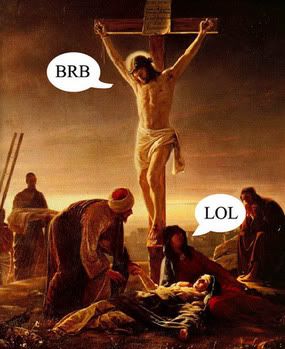
lolpolitics

As usual, I'm about five months behind the bandwagon, but before this hyper-meme explodes beyond all recognition I thought I'd throw my effort in. No real way to explain the lol___ phenomenon, so you'll just have to see it for yourself. When you know that I cut that link list down to four from about, 20, you'll get a better sense of what I did last night while hopped up on Sudafed 12-hour.

Here's mine.


Friday, February 02, 2007

TAP Letter/Change to Win

Harold Meyerson published an excellent column in the online edition of The American Prospect on Andy Stern, titled "Organization Man." TAP published my letter in response today, on their website. I didn't really imagine that they would, so I can't say that I cleared it with our communications staff. I think it's pretty innocuous, though.

Doing Something

Harold Meyerson’s recent column on SEIU president Andy Stern ("Organization Man," 2/1/07) makes a compelling argument regarding Stern’s political effectiveness and his similarities to former UAW president Walter Reuther. But, to strengthen the comparison, Mr. Meyerson likens Reuther’s failed Alliance for Labor Action to the recently-formed Change to Win Federation, which -- according to Meyerson -- "can’t really be said to have done anything, either."

Quite the contrary. Since the formation of Change to Win, SEIU organized 5,300 janitors in the union-hostile environment of Houston, TX, the UFCW mounted an effective nationwide opposition to Wal-Mart, and UNITE HERE, in an unprecedented victory, won organizing agreements with two national hotel chains. In fact, a year ago Mr. Meyerson published a Washington Post column on the revolutionary nature of the UNITE HERE campaign, which he praised for "opening a whole new front" ("Taking on the Hotels," Washington Post, 1/18/06). These milestones, along with the record participation of labor unions in the 2006 election cycle, clearly demonstrate the commitment of Change to Win members to the new federation’s founding principle of strategic, industry-based organizing. Change to Win may have faults to match its successes, but it is, without a doubt, doing something.

Alek Felstiner, Organizer
UNITE HERE Local 2

Friday, February 17, 2006

...and the response.

Who I work for, apparently.

The guy on the right is Bruce Raynor, the General President of Unite Here.

It ought to be patently obvious to anyone that his quote was taken out of context (the presence of Kim Jong Il pretty much destroys the pretense of credibility). But for the record, the quote came from a 2003 article in the NYT about UNITE's efforts to organize Cintas (archived at CommonDreams).

Here's what he said:

"There's no reason to subject the workers to an election," he said, adding that employees were often vulnerable to threats, intimidation and firing during election drives. (my emphasis)
The context is kinda important, don't you think? In fact, I wouldn't even call the threat of intimidation and harassment "context" in this case. I'd call it "a secondary clause in the same damn sentence which apparently, for stylistic reasons, the author decided to present without quotation marks."

Incidentally, violating labor law has been a matter of course for Cintas, so you can see why an NLRB-sponsored election might prompt serious concerns. This guy has a lot more in common with Kim Jong Il and Castro than Bruce Raynor.

Anyway, the ad I linked to above was created by the Center for Union Facts, a newly-formed non-profit that has gone on the attack against union organizing with front-page ads in the NYT, the WSJ, & the Post. The site itself is poorly researched at best, and libelous at worst -- if not actually in violation of labor law. As an example, check out Nathan Newman's dissection of their statistics regarding "labor racketeering." And it goes without saying that when you stock "impartial" government agencies with rabid anti-union advocates, and you instruct them to go after unions, you'll get more government cases against unions. So simple volume of cases isn't much to base an argument on -- though, as I'll get to below, the substance of those cases is indeed crucial.

The CUF is a front group. It's run by Rick Berman, who some of you may remember from his industry-funded attacks on smoking laws, drunk-driving laws, health laws, and environmental laws. If that doesn't float your boat, how about his industry-funded attacks on the minimum wage laws, living wage laws, and healthcare laws? Yup, that's him too. Quick CV: he's worked as a labor lawyer for steel & auto producers. He's worked as a lobbyist for food, alcohol, & tobacco industries.

And -- wait for it -- he was the labor law director of the US Chamber of Commerce under Nixon.

So, no big surprises there.

What's funny about the site, to me, is that no matter how corrupt and greedy they try to make unions look, the numbers that are supposed to shock us are actually pretty paltry. The president of an international union makes $200,000 a year? Good lord! And the political contributions, which are supposed to enrage the common man, are comically small compared with industry counterparts. In fact, they're small compared with the $5 million/year Berman plans to spend on this campaign.

HOWEVER: It should definitely be noted that the CUF site, though its contents are hopelessly biased in their presentation, does offer a wealth of details in the areas of corruption & criminal behavior. Labor movement proponents (including myself) have often been heard to argue that crime and corruption are just as prevalent, or more prevalent, in corporate America or government as they are in organized labor. While this may be true, there's a reason we hold ourselves to a higher standard, and we can't choose when that standard is enforced. The actions of union leaders in practicing, condoning, or ignoring corrupt/criminal behavior within their organizations is despicable, and should be decried at all levels of the movement, and outside it.

The thing is, of course, that exposure isn't what they're after. Berman admitted as much when he was working for the restaurant industry, in an interview the Chain Leader trade publication (link unavailable):

“Our offensive strategy is to shoot the messenger. Given the activists’ plans to alarm beyond all reason, we’ve got to attack their credibility as spokespersons.”

It would be great if a site called "Union facts" actually contained a balanced presentation of, well, union facts. Like the union/non-union wage differential, unionization rates in public/private sector, by industry, skill level, etc. Benefits across union/non-union professions, union stance/involvement in various social/political issues, history, relevant law & how it's generally applied, etc. That would put the corruption, crime, and political contributions in context, and -- I'd argue -- would do a lot more to erode call attention to the existing problems.

Monday, January 30, 2006

VrrrrrrrRRRRROOOOOOOOM!!!

Via The Rest is Noise, a new ad from Honda UK.

My favorite is the rolling pencil.

By the way, I think it's worth keeping in mind when you're watching something like this how successfully these ads build an association in your mind between the personality of the ad and that of the company.

Honda is not dedicated to creative, witty, innovative media explorations. It's just a car company with a great marketing department, and an even greater talent for contracting with terrific marketing agencies.

Despite that ad that's gotten me misty on a few occasions, Honda is not in the business of making childrens' dreams come true by building cars based on their crayon drawings. Honda is in the business of systematically dismantling the US and European auto markets by offering a cheaper, higher-quality alternative.

Honda will never get anywhere with the macho, patriotic angle. Unlike Ford, you would laugh out loud if a Honda add contained the slogan "Built Honda Tough." Or "The 2006 Civic - Like a Rock."

So they go with the playful, technologically savvy persona that gets under your skin and makes you feel like buying a Honda to go with your Wired subscription.

Anyway. Speaking of playfull & technologically savvy, I went to the last night of the San Francisco Tape Music Festival on Sunday. "Review" forthcoming.

Tuesday, March 08, 2005

the blogoshield

Sometime this week a Superior Court judge in Santa Clara will rule on whether California's Shield Law -- which protects journalists from being held in contempt for refusing to honor a subpoena of unpublished information, like sources -- applies to blog journalists.

A few bloggers published some information about unreleased Apple products and are now being sued for the sources who may have leaked the information.

Blah blah, I could care less about Apple's guarded secrets ("it's another, smaller, weirder version of the iPod!!!"), but obviously this case matters in the current media climate, where web logs have emerged as an unrivaled source for hidden news and investigative journalism. So, denying them journalistic protection would constitute a serious threat to the principles of free press.

See, here in California we decided that the protected existence of free press was more critical to the health and welfare of our democracy and our society than the ability of courts to successfully subpoena unpublished notes and sources. It's something of an arbitrary trade-off, but the expectation is that journalists will use that protection to make sure the public receives an accurate and balanced picture of the world in which they live. The Shield Law protects a journalist, and not a fence for stolen goods, because society and its lawmakers have deemed the information worth protecting in the case of the former and not the latter.

People don't consider bloggers journalists because lots of them are crackpots. Unfortunately, so are lots of "legitimate" journalists who receive protection from the Shield law simply because they're employed by something that at least refers to itself as a news-gathering organization. But the Shield Law covers any "publisher, editor, reporter, or other person connected with or employed unpon a newspaper, magazine, or other periodical publication, or by a press association or wire service," as well as any "radio or television news reporter or other person connected with or employed by a radio or television station." There's nothing here that explicitly exempts crackpots, bad journalists, or even one-person self-published operations.

Another faulty assumption at work here is that since the technology opens up "journalism" to anyone, the bloggers' credibility and integrity must unavoidably suffer. This is also unsupported, and what's more, if credibility and integrity were at issue in the Shield law, then it would simply explode from subjectivity. Not to mention the fact that "journalism," as defined as the periodic public dispersal of gathered information, has always been open to anyone.

So, it's up to the court to figure out whether blogs fit the tradition mold of news-gathering organizations. The Chronicle article suggests that one criterion might be the exercise of editorial control, though that seems a little vague to me. Perhaps the assumption here is that editors are the people who intervene on the public's behalf, ensuring the accuracy and balance of the information. Maybe I need to learn more about this, but unless news editors sign some contract with the FCC to check their sources, I don't see why they would qualify as gatekeepers of journalistic integrity.

It's probably worth noting that the trade-off I'm describing is theoretical, and won't likely be the main bone of contention in the Apple case. The judge seems poised to either rule against the Shield Law itself, position this case as one of the allowable exceptions to it, or decide that it does not apply to blogs. If he chooses the third option, simple "reporter's privilege" will not help the bloggers because their evidence certainly goes to the heart of the matter. I dunno.

I personally am not likely to be sued for my sources anytime soon. I'd have to be, y'know, a journalist for that to happen. If it does, though, the detailed legal argument above will, I'm confident, provide me with a blogoShield so strong it'll make our missile defense system look like oh wait never mind.

Friday, March 04, 2005

radio trivia

This issue came up recently, and only today did I bother to find the answer to one of the oldest mysteries of teenage life.

Why do songs sound better on the radio?

Anyone out there with a working knowledge of audio processing already knows the answer to this. Those with a defective knowledge of audio processing, like me, have probably developed a complex and ultimately stupid set of explanations for what is essentially a simple phenomena...as I did.

You all know what I'm talking about. That song you loved in Junior High (for me it was "Today," by the Smashing Pumpkins) that always sounded wrong except when it was blasting over your favorite crappy alternative station.

Why do songs sound better over the radio?

The answer is, predictably, corporate greed and a hatred of music. That's my answer to everything, by the way.

Okay, so let's look at the relevant institutional actors.

1) Record Companies - How do they primarily market their music (at least the audible component)? Radio, MTV, Retail listening stations. Above all, they want it to be LOUD. Because, God forbid, the song/video that came before might do more damage to their target demographic's ear canal, and they'd lose the sale. So they pressure record producers to compress, compress, compress. Compression is an artificial way to make music louder by amplifying all the audio material and slicing off the very loudest bits, eliminating the quiet parts and making the whole thing sound louder. They're pre-tailoring it for car radios, listening stations, or any other medium that requires the music to punch through a lot of ambient noise.

2) Radio stations - The FCC gives them 200MHz of bandwidth, and what they can get out of it largely determines their ability to attract an audience. So, they're also worshipping the gods of LOUD, and they also compress. They sacrifice dynamic range for a punch in the gut, because they want to wrench your attention towards whatever music they're playing (same theory for the loudness of TV advertisements). The compression fetish is even more common amongst "oldies" and "mix" stations, because they need all their songs to sound the same. In order to make "Heard it Through the Grapevine" sound as loud and present as "Genie in a Bottle" (just kill me now), they need compression. Also radio stations understand that, for the most part, their broadcasts are projected over crappy speakers. Multi-band compression will boost the bass to adjust for tinny-ness, while putting the whole, squashed mess into a comfortable, non-squawk range for your TV speakers and dentist's office.

3) Artists & producers - They want to sell their records, and they need (1) and (2) to do it. This is a no-brainer.

So it's a symbiotic relationship. Albums are mastered 10 times and polished to achieve that gut-punch no matter what. Stations pick music that is already pre-compressed, or will sound good when squashed to hell.

The result? On one hand, music with dynamic range gets distorted or is never made in the first place. On the other, everything that does get played comes out flat and LOUD. If you wonder why some people tell you that "rock all sounds the same nowadays," that might be the reason. Personally, I think the disgust directed towards Top 40 radio for its homogeneity comes partly from the compression fetish.

Does music sound better on the radio? On objective, audiophile terms, it actually sounds worse. But it all depends what you like.


Wow, that was more boring than I thought.

For some reason, this topic had an air of mystique and nostalgia when I thought about it in my head. Not so much now.


Okay folks, move along, nothing to see here.

Tuesday, March 01, 2005

a little internat'l development humor

Okay, I know I promised that I wouldn't just regurgitate current events via newslinks. But, like my father says each time he breaks one of his many promises not to send me shit he cut out of the newspaper, this is just too good to ignore.

The content of today's NYT article on possible successors to Wolfensohn at the World Bank is, in and of itself, scary and depressing. But the Times managed to slip in two one-liners which I thought were, in context, hilarious.

With this appointment, President Bush will have a chance to name his own person to lead the World Bank. (By tradition, the United States names the head of the bank while Europe names the director of the International Monetary Fund; all the countries left out of the process would like that tradition changed.


Wait, other countries don't like that setup? No kidding.

And, inserted as an afterthought in the article's final sentence:

Ms. Fiorina would also add a touch of glamour to the post, since she is probably the only candidate famous enough to be known in business circles by her first name, Carly.

As the assistant secretary of state for East Asia and later United States Ambassador to Indonesia, Mr. Wolfowitz did oversee policy covering the developing world. But neither Mr. Wolfowitz nor Ms. Fiorina is an expert in development.


This makes sense, right? When it comes to the highest decision-maker in a Bretton Woods institution, you want someone with first-name recognition, like Oprah. Or Liberace.

And, as the article points out, being an "expert in development" shouldn't be particularly important for the leader of the World Bank, anyway.

Tuesday, February 22, 2005

where the wild things check air pressure

Last week a handful of billboards went up for Esuvee.com, with a picture of a guy riding an enormous Maurice Sendak-like monster with headlight eyes and a chrome-grill mouth, and the slogan "An SUV is not a car." Y'all have probably seen this thing around. Anyway, I assumed that it was a bold and brilliant anti-SUV ad campaign, and for a few days we cheered when we passed it on the Bay Bridge onramp. Then I finally visited the site, and it turns out that it's an SUV safety campaign, and the evil ogre is actually a friendly SUV monster who needs love and attention -- in the form of air-pressure maintenance/defensive driving -- to stay safe and happy. Normally I'd say I'm all for an SUV safety campaign, but entering site gave me the same turned stomach as when I first visited this little hypocritical marvel.

I may be reading this entirely wrong, of course. But spending lots of money to educate drivers on how to avoid dying (or more likely, killing someone else) when operating a vehicle whose design and structure are inherently, fundamentally unsafe seems a little bizarre to me. Hence the comparison with Phillip Morris. If you want to reduce the consumer risk of a product that has been approved by a federal regulatory agency, stop approving it! This is why the FDA has not approved DDT for use at French restaurants, and why the National Highway Traffic Safety Administration doesn't let you ride a giraffe down I-95. This is just another instance of government agencies dumping liability onto consumers so as to avoid pissing off major lobbying interests by actually holding them responsible for the safety and legality of their product.

This ESUVEE campaign also gives off a pungent aroma of assuaged upper-middle-class guilt. Now, if people buy hybrid models and follow all the friendly monster's instructions, it'll finally be okay to own an SUV. For those of you unfamiliar with that assuaged-guilt smell, just think of a Starbucks shade-grown mochachino and you're pretty close.

I guess the site I was hoping for would probably be called something more like "Effuvee.com." Not holding my breath, though.

Wednesday, February 16, 2005

hold tight

folks waiting for the New Plastic Music update, chill!

it's coming, i'm just having some server problems. i'll keep you posted.

in the meantime, let's play a little game.

click this link, then assign it a rating on a "problematic" scale of 1 to 10, with 1 being "completely PC," 5 being "Halliburton," and 10 being the NAACP giving Fred Phelps an award in 1986 (this really happened).

peace.

Friday, February 04, 2005

good, bad, ugly

Good:

Last week's feature on Andy Stern and SEIU in the NYT Magazine was pretty good, but folks who've talked to me about it since know that I wouldn't have minded a little more attention paid to the people who actually built the SEIU movement on the ground. Credit to Stern for immediately posting an entry to that effect on the Unite to Win blog. It's eloquent, fairly humble, and worth reading. The other thing that was missing from the piece was a full (and unbiased) explanation of why some workers oppose Stern's agenda, and why in particular some workers feel that independent or micro-industry-focused unions are more effective. Look elsewhere on the Unite to Win blog for more on that, or check out the summary by Labor Notes.

Bad:

This isn't new news, but as of today it looks like Benon Sevan is gonna go through the ringer for soliciting oil sales while director of the U.N. Oil-for-Food program in Iraq, in violation of all kinds of laws. It seems a little unclear to what extent Sevan is actually guilty, but it's bad from every angle.

Ugly:

Fox News wasted no time making U.N.-funded terrorism their top story, and crackpots across the nation rejoiced. This will also doubtless give Bush & his Crony All-Star Team more fodder for their arguments that the U.N. can't fight terror effectively.

Hooray for sanctions!!
(personally, I think that would have been a better name for Bloodhound Gang's first album)